
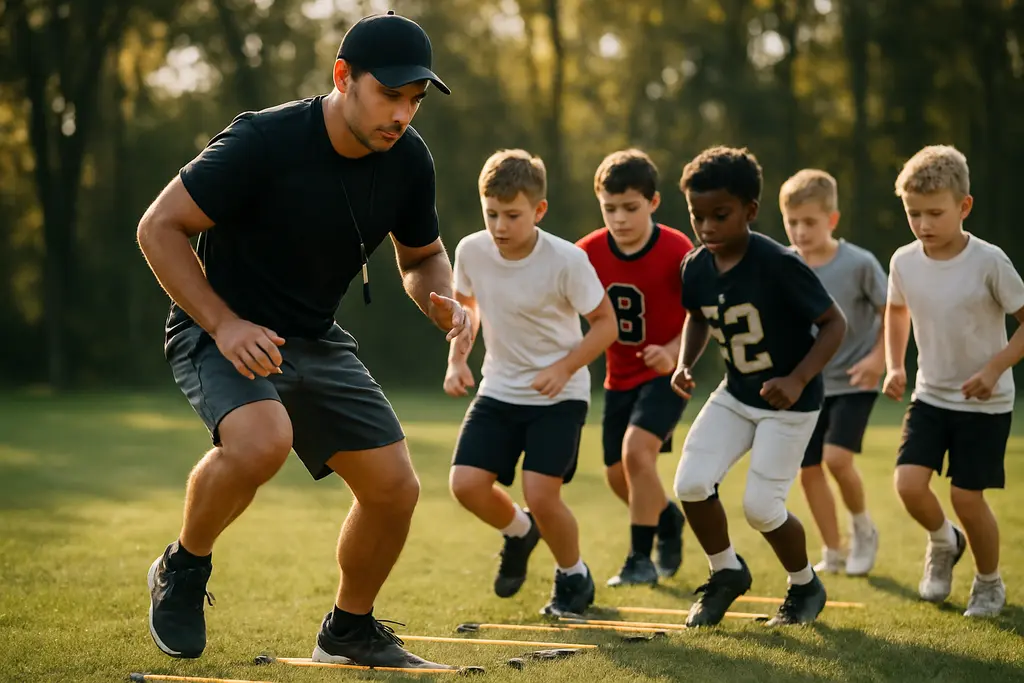
Youth Football Skills give coaches in the New Bryan League a practical way to teach more than stance, footwork, catching, blocking, and tackling. They can also teach patience, accountability, listening, and respect for teammates. Because the research notes provided do not include verified league schedules, team lists, venues, or staff names for the New Bryan League, this article stays focused on what can be supported: coach habits, movement teaching, safety language, and youth development ideas that fit a community football setting in Bryan.
That matters for families because youth football is often one of the first places a young athlete learns how to take correction in public, try again after a mistake, and trust a coach who is asking for effort before praise. A good technical plan does not have to feel cold or mechanical. Done well, it becomes the daily structure that helps kids understand why details matter.
Youth Football Skills Start With Movement
Why Movement Basics Carry The Lesson
Before a player can handle a play call, he or she needs control of the body. Running, jumping, balance, stopping, starting, and changing direction are not extras; they are the base layer for learning sport technique. A 2024 study of 162 boys ages 7 to 14 found that fundamental movement skills were the single most important predictor of technical soccer skills, with predictive models reaching 99% accuracy fundamental movement study. That study was in youth soccer, not American football, so Bryan coaches should not treat it as a football-specific proof point. Still, it offers a useful coaching reminder: young athletes often need movement confidence before they can perform sport-specific skills under pressure.
For football coaches, that can mean shorter teaching blocks, more repetition, and fewer lectures. If a player struggles with a route break, the issue may not be effort. It may be deceleration, balance, hip control, or body position. If a young lineman cannot stay square, the lesson may begin with foot placement and posture before any talk about winning the rep.
Teaching Youth Football Skills Through Stations
Stations can help a New Bryan League practice stay organized and active. One group can work on footwork through cones, another on ball security, another on stance and start, and another on safe body position. The goal is not to rush kids from drill to drill. The goal is to create small spaces where coaches can give clear feedback and players can improve one detail at a time.
That structure also builds life lessons. A player who waits his turn learns patience. A player who repeats a drill after losing balance learns that correction is not punishment. A player who cheers for a teammate begins to understand that practice is shared work. Technical coaching gives those values a place to live because the lesson is tied to an action the athlete can see and feel.
For local staffs that want a simple starting point, short drills and warm-ups can be paired with game-like reps. The same approach is reflected in this site’s discussion of youth coaching in Texas, where teaching with confidence and age-appropriate pacing is the focus.
Safe Contact Teaching And Accountability
Tackling Technique As Shared Language
Contact instruction deserves careful language. Coaches should never promise that any drill removes risk from football. What they can do is teach consistent body position, clear expectations, and safer habits within the limits of the sport. In a qualitative study of youth football coaches’ views on concussion safety, 78% of coaches believed tackle football should begin at or before age 8 so young players could learn proper tackling technique early and potentially reduce future injury risk CDC coach safety study. That finding reflects coach perceptions, not a guarantee of injury prevention.
For the New Bryan League, the responsible takeaway is not to push contact earlier for every child. The takeaway is that coaches need a shared teaching vocabulary before contact work begins. Players should hear the same cues from every adult on the field. Families should know what those cues mean. Assistants should correct unsafe habits the same way, whether the player is new, advanced, big, small, confident, or hesitant.
Correction Without Shaming
Accountability works best when it is specific. “Keep your eyes up,” “reset your feet,” or “secure the ball high and tight” gives an athlete a next action. “Be tougher” may sound emotional, but it gives a young player little to use. In community football, where athletes develop at different speeds, the words a coach chooses can shape how a child sees effort.
Technical correction also teaches honesty. If a player misses an assignment, the coach can name the mistake, show the fix, and give the athlete another rep. That cycle helps kids learn that being corrected is part of belonging to a team. It also helps parents see that discipline can be firm without being personal.
Practice Design For Character Development
From Reps To Responsibility
Youth Football Skills should not be separated from character goals. A ball-security drill can teach responsibility because one lapse affects the group. A blocking-fit drill can teach trust because teammates need each other to use safe and consistent technique. A route drill can teach communication because the throw, break, and catch depend on timing between players.
One useful approach is to connect each technical period to one plain-language value. Footwork can pair with focus. Tackling form can pair with self-control. Team pursuit can pair with effort. Coaches do not need long speeches. A short cue before the drill and a short question after the drill can help athletes connect the work to behavior.
Reflection After Technical Errors
Reflection is often where the life lesson becomes clear. After a dropped pass, a missed flag pull, or a poor angle, a coach can ask, “What did you see?” or “What will you change on the next rep?” That keeps the athlete involved in learning rather than waiting for an adult to supply every answer.
This is where Youth Football Skills can support confidence. Young athletes gain confidence when they know what improvement looks like. A coach who says, “Your first step was better than the last rep,” gives a player evidence. A coach who says, “You are getting it,” gives encouragement, but less direction. Both have a place, yet the technical detail helps the encouragement stick.
Communication With Families In The New Bryan League

Clear Expectations Before The First Rep
Since verified public details about the New Bryan League were not included in the research notes, families should look for official league communication on registration, divisions, schedules, safety procedures, and coach requirements. Coaches can still prepare now by agreeing on how they will explain practice goals to parents. A parent meeting does not need to be long, but it should answer basic questions about teaching progression, contact limits, equipment expectations, hydration, and how concerns should be raised.
Families often judge a league by what they see at practice. Are coaches organized? Are kids moving? Are corrections clear? Are players treated with respect? A technical plan helps answer those questions in visible ways. It shows that coaches are not improvising with children’s time or safety.
- Use common cues: Keep teaching words simple enough for players and parents to understand.
- Limit standing time: Small groups and stations help young athletes stay involved.
- Explain the why: Tie drills to safety, teamwork, confidence, or game understanding.
- Repeat core habits: Young players learn through steady practice, not one long talk.
Coaches As Community Teachers
In Bryan, youth football can be part of a larger local sports identity that includes school pride, weekend family routines, and neighborhood relationships. Coaches carry that responsibility every time they correct a child in front of teammates. The best technical teachers are not only chasing sharper execution. They are building an environment where players feel safe enough to try, fail, listen, and try again.
That does not mean lowering standards. It means making standards teachable. A coach can demand effort while still explaining the task. A coach can hold a player accountable while still protecting dignity. The strongest youth programs often feel steady because the adults are steady.
What Youth Football Skills Mean For Bryan
Youth Football Skills give the New Bryan League a chance to define success in a responsible way. Wins, scores, and standings may matter to competitors, but the more lasting measure for a young league is whether players leave practice better prepared, safer in their habits, and more connected to their teammates.
The research available here supports a simple message for coaches: start with movement, teach technique with care, use clear words, and connect each rep to a life lesson the athlete can understand. Bryan families do not need exaggerated promises. They need coaches who can teach the game responsibly and help children carry its lessons beyond the field.