
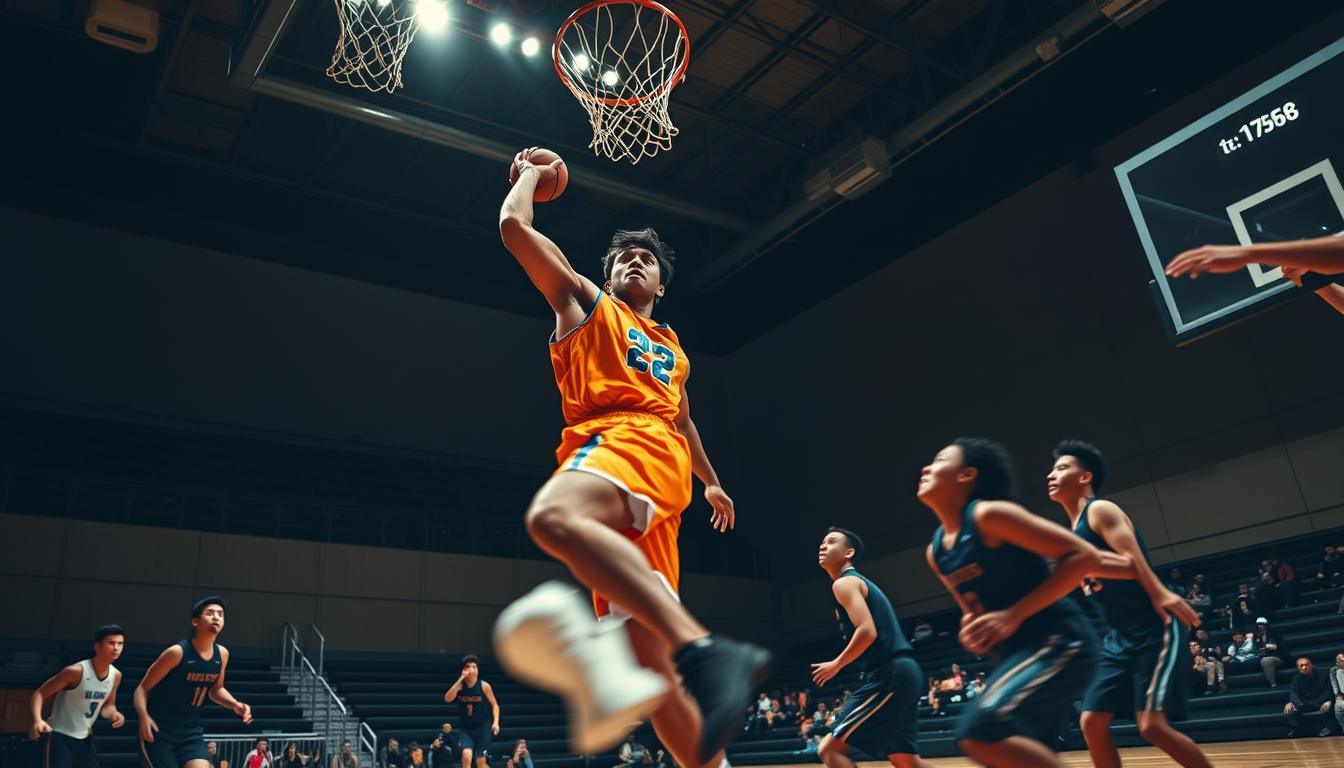
Capturing the energy of a fast-paced game in a dimly lit gym is exciting. But, turning that excitement into sharp, compelling images is often a frustrating battle against the environment.
The main challenge is the light itself. Many school arenas and community gyms have poor quality, low-level lighting. This lighting can damage camera sensors. A camera with excellent high-ISO performance and a lens with a wide aperture, like a 70-200mm f/2.8, is essential for clear shots.
You’re also up against speed. Athletes move in sudden, unpredictable bursts. To freeze a dunk or a dig, you need very fast shutter speeds. Plus, using flash is often not allowed during high school games, making things even harder.
These obstacles—tough gym lighting, fast action, and gear limitations—are why pro-level results are hard to get. To overcome them, you need specific techniques and the right equipment. For more tips, check out this resource on indoor sports photography tips.
Conquering the Gymnasium
The secret to great Indoor Sports Photography starts before the game. You need a conqueror’s mindset to capture the game’s energy. Plan, scout, and know the field.
Arriving early is key. This time lets you study the gym lighting. Look for the brightest spots, like under lights or near windows. Use your camera’s Anti-Flicker setting for better shots under harsh lights.
Knowing the sport is as important as your camera. Understanding the game’s flow helps you catch key moments. Great photographers don’t just shoot randomly. They watch and wait for the perfect shot.
Choosing where to stand is a big decision. Here are some top spots:
- Opposite Team Benches: Gives a clear view of the action.
- High in the Bleachers: Offers a wide-angle view of the game.
- Baseline Corners: Great for shots of drives to the hoop.
Always be aware of your surroundings. Stay out of officials’ views and avoid active areas. Your safety and the athletes’ safety are most important.
This groundwork—scouting, studying, and choosing spots—is what makes photos stand out. It’s the foundation for all camera settings for crisp action shots. Mastering the gym is key.
With good preparation and techniques, you turn a tough space into your own studio. You go from reacting to the game to telling its story with purpose.
The Problem with Fluorescent Lighting
The uneven, flickering light from standard gym fixtures is a big problem for clear volleyball photos. Most gyms are great for playing but bad for taking pictures. Flash photography is often banned, leaving you stuck with the gym lights.
These lights are dim and create an uneven “spotlight” effect. You’ll see bright spots under the lights and dark shadows elsewhere. It’s hard to get a consistent exposure as players move around.
Fluorescent lighting also has two big issues. It often gives skin and clothes a sickly, unnatural color. Plus, the lights flicker at a frequency that’s bad for camera sensors.
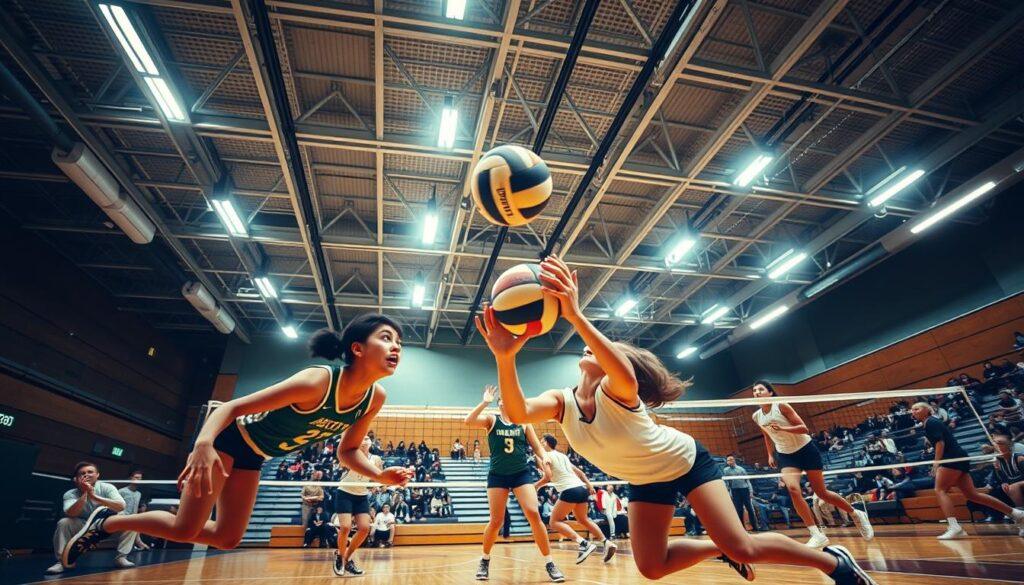
This flicker and unevenness mess with your camera’s light meter and autofocus. The meter gets confused by the changing brightness, leading to shots that are too bright or too dark. Autofocus might also struggle, missing the action and making photos blurry.
Photographers have to make tough choices to get good shots. They use wide-aperture lenses to grab more light and raise the ISO to brighten the image. But this can introduce digital noise, making the photos worse. A key tool is the Anti-Flicker setting, which helps the shutter fire at the right time to reduce dark bands and exposure issues.
This tough lighting is why many amateur Indoor Sports Photography fails. To get sharp, well-exposed volleyball pictures, you need to know how to work around these problems with the right gear and techniques.
Why Smartphone Cameras Struggle Indoors
Smartphones do great in daylight but fail indoors. Parents, coaches, and fans often get blurry, grainy photos. It’s not because of how they use the camera. It’s because of the camera’s limits in indoor sports photography.
The main problem is the small image sensor. Professional cameras have much bigger sensors. In dim light, a small sensor has to work harder to capture light. This leads to digital noise, making photos look grainy and lose detail.
The lens aperture is another big issue. Most phones have a fixed, narrow aperture. Professional lenses for basketball photography can open wide to let in more light. But phone lenses are smaller, letting in less light. This means slower shutter speeds, causing motion blur.
To freeze fast action, you need a very fast shutter speed. But smartphones often can’t keep up. This results in blurry photos of athletes, even if the background is sharp.
Smartphones also have limited burst mode. They can’t take many photos quickly before slowing down.
Here are the main reasons smartphones struggle indoors:
- Small Sensor: Creates excessive noise in low-light gyms.
- Fixed Aperture: Severely limits light intake compared to professional lenses.
- Slow Autofocus: Struggles to track rapid, unpredictable movement.
- Processing Lag: Cannot sustain the high shutter speeds needed to freeze motion.
Knowing these limitations helps us understand why even the latest phones can’t capture sharp, clear photos indoors. The difference between what phones offer and what pros need is huge. This shows why specialized equipment is needed to overcome these challenges.
Professional Strobe Lighting for Team Shots
Off-camera strobe flashes are key to making athletes stand out against dull backgrounds. They freeze fast action. While venue lighting is good for general light, it’s not enough for critical shots. Professional strobe lighting turns a tough gym into a studio.
These flashes solve gym lighting problems. They light up fast to freeze basketballs mid-swish or volleyball spikes. This stops motion blur. Plus, they ensure consistent exposure for every shot, not just flickering lights.
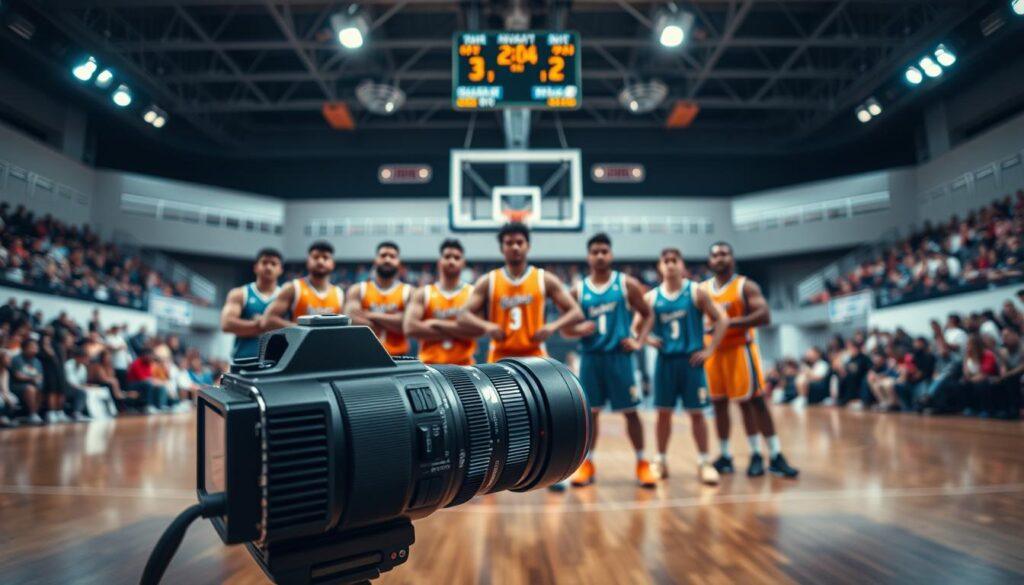
Strobes are essential for team portraits and posed action shots. They make athletes sharp and clear against the background. This is vital for basketball photography. Pros often use the Nikon SB800 speedlight, placed off-camera and at an angle.
Proper strobe placement is key. You don’t want to blind players. Set up strobes off-center, like from the sidelines or corners. This lights the scene without shining in athletes’ eyes during free throws.
Always check venue rules before setting up. Some places have strict flash policies. Your budget and access matter too. Even one well-placed strobe can greatly improve your Indoor Sports Photography.
Using strobes safely and with respect lets you get perfect shots without interrupting the game. You can ensure perfect exposure, capture clear moments, and get great team photos every time.
Capturing Fast Action in Low Light
To conquer the blur of fast-paced indoor sports, your camera settings must work together as a precise system. Indoor Sports Photography demands you master three key controls: shutter speed, aperture, and ISO. Getting just one wrong can turn a great shot into a disappointing blur.
Think of these settings as a team. They must balance each other out to let in enough light while freezing motion.
Your shutter speed is your most important setting for action. It controls how long your camera’s sensor sees the scene. A slow speed will record motion as a streak. A fast speed freezes it.
For sports like basketball or volleyball, you need a very fast shutter. Start at 1/500th of a second as a minimum. For truly sharp volleyball pictures of a spike or a basketball drive, aim for 1/1000th of a second or faster. This speed stops the ball and the players’ hands mid-air.
Once your shutter is set to freeze action, use your aperture and ISO to get a bright enough image. Set your lens to its widest aperture, like f/2.8 or f/4. This lets in the most light possible.
Your ISO makes up the difference. In dim gym lighting, you will need a high ISO, like 3200, 6400, or even higher. Modern cameras handle high ISO much better than old ones. Some noise in a sharp photo is better than a blurry, clean one.
Great settings are useless if your subject is out of focus. For moving players, use your camera’s continuous autofocus mode. On Canon cameras, this is called AI Servo. On Nikon and Sony, it’s AF-C. This mode constantly adjusts focus as your subject moves.
An advanced trick is to use back-button focus. This separates the focus function from the shutter button. You use your thumb to focus and your index finger to shoot. It gives you total control and prevents the camera from refocusing at the wrong moment.
Even with perfect focus, timing is hard. Use your camera’s high-speed continuous shooting mode (burst mode). Hold down the shutter to take a rapid series of shots. This increases your odds of capturing the perfect peak action moment, like a ball leaving a player’s fingertips.
| Sport/Action | Shutter Speed | Aperture | ISO (Example) | Focus Mode |
|---|---|---|---|---|
| Volleyball Spike / Basketball Drive | 1/1000s or faster | Widest (e.g., f/2.8) | 3200 – 6400 | AI Servo / AF-C |
| Fast Basketball Pass / Soccer Kick | 1/800s – 1/1000s | Widest (e.g., f/2.8) | 1600 – 3200 | AI Servo / AF-C |
| Team Huddle or Celebration | 1/250s – 1/500s | f/2.8 – f/4 | 800 – 1600 | Single Shot AF |
| General Gym Lighting Reference | Minimum 1/500s | As wide as possible | Adjust to expose | Continuous AF |
Use the table above as a starting point. Every gym is different. The key is to set your shutter speed first to freeze motion. Then open your aperture all the way. Lastly, raise the ISO until your exposure looks right. With practice, this process becomes second nature for all your Indoor Sports Photography needs.
Tips for Basketball and Volleyball Leagues
When you’re covering community or school leagues, you need to adjust your indoor sports photography skills. For basketball, stand along the baseline. This spot lets you see the action clearly, from drives to defensive stands.
For volleyball, get low near the net. Shooting up captures the height of spikes and blocks. Use vertical shots to follow the action smoothly.
Don’t just focus on the main play. Capture the coach’s reactions or a fan’s joy. These moments tell a story. Always include a player’s face and jersey number for identification.
Be creative with your shots. Try shooting through the volleyball net or from the stands in basketball. In editing, smart cropping can make an action shot into a powerful portrait.
Respect is key in league settings. Talk to coaches and officials before the game. Stay out of their sight and avoid flash during play.
Mastering indoor sports photography for basketball and volleyball is about technical skills and an eye for the game. It’s about freezing action and capturing the emotions of the game.