
For years, I treated my camera’s autofocus like a magic box. I’d ask for sharp photos and hope for the best. It was a purely transactional relationship.
Then I met veteran photojournalist Patrick Murphy-Racey. He said his camera was “the greatest sports camera ever made, period.” He wasn’t talking about the metal and glass. It was the focus system he admired.
This is where the game is won or lost before you press the shutter. Think of it as your photographic quarterback. It calls the right play based on the game’s chaos.
Whether you’re a pro or a parent, capturing that perfect moment is key. It’s the difference between a lucky snapshot and a deliberate victory.
Murphy-Racey’s passion is contagious. “I am totally enamored with tracking… it leaves not a crumb on the ground.” We’re about to learn how to leave the competition with nothing but crumbs. Start by mastering focus points and modes.
Zone vs. Single-Point vs. Tracking
In sports photography, your autofocus choice is like choosing a political system. It’s not about the gear, but about who’s in charge. You decide how much control you give to your camera’s brain.
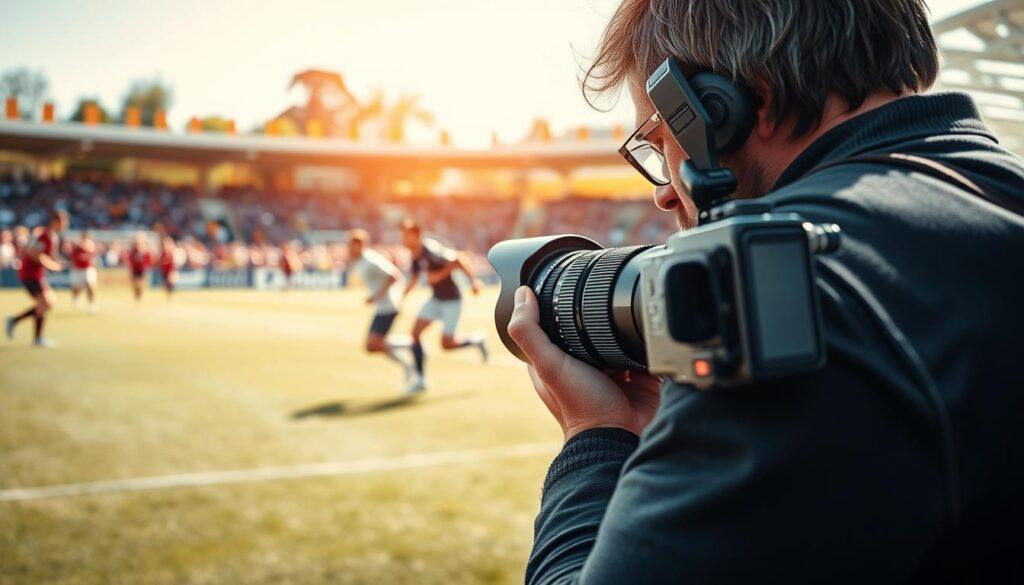
There’s a spectrum of choices. You can have total control or trust the camera’s AI. The scene and your lens’s aperture decide which way you go. Let’s look at the main options.
Single-Point AF: The Micromanager’s Manifesto
This method is all about control. You pick the exact focus point, and the camera follows your command. It’s great for situations where everything is steady, like a portrait or a player in a calm moment.
But, it’s not good for chaotic scenes. If your subject moves, focus can fail. You’ll need to keep adjusting the focus point, like a dictator managing every detail.
Also, with slower apertures, you lose focus points. This is why even those who prefer tracking might use Single-Point for certain shots.
Zone AF: The Committee Approach
Zone AF is like a democracy. You choose a main point, but the camera also looks at nearby points. Nikon calls this Dynamic-area or Group-area AF. It’s a balance between control and trust in the camera.
If your subject moves a bit, the camera can adjust. It’s more flexible than Single-Point but not as hands-off as Tracking. It’s a good choice for situations where things move a bit but stay in one area.
Tracking AF: The AI Campaign Manager
Tracking AF is all about trust in AI. You tell the camera who to follow, and it uses color and distance to track them. Sony and Nikon have their own versions of this. It’s like having a smart manager who focuses on your subject.
This manager doesn’t get distracted by other players. Sports photographer Bradley Murray-Racey loves it for its reliability. He trusts the camera to follow his subject.
He usually uses Tracking with a Flexible Spot: M (Medium). But he adjusts based on the situation. For distant shots, he uses Flexible Spot: S (Small) to get precise focus. It’s all about adapting to the scene.
This approach changes how you think about focusing. You’re focusing on a person, not just a point. It lets cameras follow fast-moving players with ease.
The Hardware Reality Check
No autofocus system works without limits. Your camera’s design can limit how many focus points you have. This is like a policy being blocked by lack of resources.
Understanding these limits is key to mastering autofocus. The camera’s brain is powerful, but it’s not perfect.
Choosing Your Government
So, which autofocus system is best? It depends on the situation.
- Single-Point for static subjects, precision portraits, or when you need absolute, manual-like control.
- Zone for predictable motion where your subject might briefly leave the chosen point but generally stays in the neighborhood.
- Tracking for erratic, high-speed subjects moving in three dimensions through clutter.
The trend is clear. As AI improves, photographers give more control to the camera. The question is, do you want to be in charge, part of a team, or let the AI do it all? Your choice affects your photos and your relationship with the camera.
Back-Button Focus Setup
Back-button focus is more than a setting; it’s a change in how your camera works. The usual way, where the shutter button does everything, can cause problems. It’s like having one person in charge of everything, leading to chaos.
Sports photographer Murphy-Racey uses a basketball example to explain. Imagine you’re following a point guard and your finger is on the shutter button. Then, a referee comes into view. With the usual setup, you have to lift your finger to avoid focusing on the referee. This means you might miss the shot.
The problem is that your camera can only do one thing at a time. The back-button focus solution fixes this. Your thumb uses the rear AF-ON button for focus, and your index finger uses the shutter for the shot. This way, you can keep focusing on your subject even when something else appears.
The Separation of Powers
This is like having checks and balances in your camera. By setting “a4: Assign AF-ON button” in your camera’s custom settings, you create a new way of working. Your thumb gets to decide when to focus, giving you more control.
This change makes a big difference. You can:
- Keep following a moving subject without losing focus
- Change your shot while keeping your subject in focus
- Ignore distractions that would normally take focus away
- Switch between different autofocus modes easily
This setup makes your camera more useful. A detailed guide to back-button focus explains how it gives you more control. It’s very helpful in situations like youth sports, where things are always changing.
The Neurological Rewiring
Switching to back-button focus is not just a setting change. It’s a change in how your brain works. “You have to practice until it becomes second nature,” says Murphy-Racey.
At first, it feels strange, like trying to write with your non-dominant hand. Your brain is used to focusing with the shutter button. Changing this takes practice, but it’s worth it for the ability to focus without thinking.
This change is very useful for fast-paced action. As noted in sports photography camera settings, quick reactions are key. Your thumb becomes automatic, letting you focus on other things.
Changing takes time, and you’ll make mistakes at first. But keep trying, and soon it will feel natural. Your thumb and finger will work together seamlessly, letting you capture the moment perfectly.
Sport-Specific AF “Cases”
Switching from autofocus theory to sports photography is like moving from reading a policy paper to managing a live crisis. Everything becomes messy, urgent, and demands specific solutions. You go from being a technician to a strategist, creating “cases”: custom autofocus protocols for specific sports.
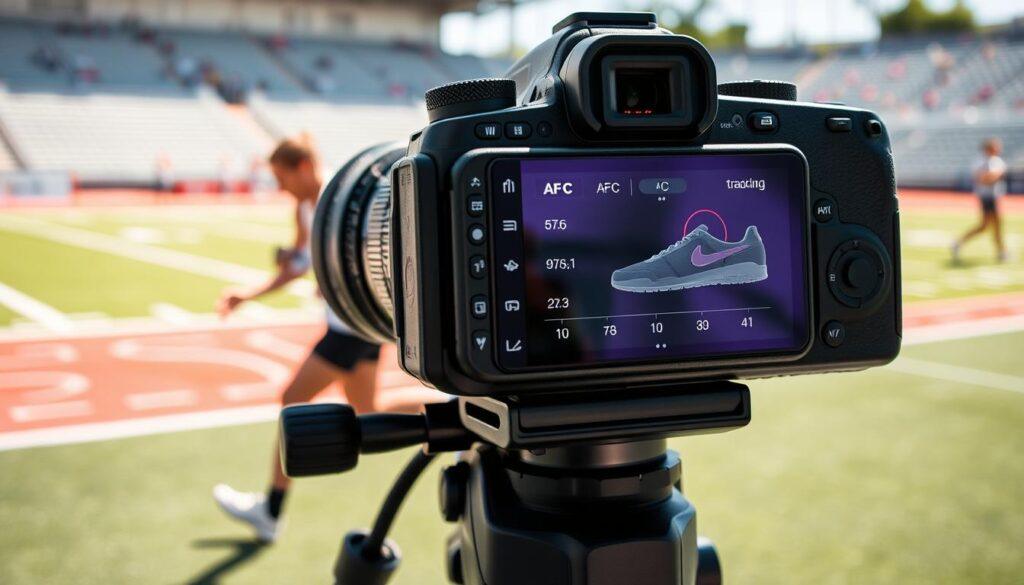
Your first commandment for action sports? AF-C (Continuous Servo AF). It’s not a suggestion; it’s essential. Think of AF-C as your scout, constantly updating focus.
Building Your Campaign Platform: The Custom Settings
With AF-C as your platform, the real work is in Custom Settings. Here, you create specific rules for your camera’s behavior. Let’s look at the key areas:
Focus Tracking with Lock-on (Custom a3)
This is your “obstruction tolerance” slider. It determines how your camera reacts when something blocks your subject. Set it to “Long,” and your focus stays strong, ignoring obstacles. Set it to “Short,” and it quickly changes focus, perfect for fast subjects.
AF-C Priority Selection (Custom a1)
Here, you choose your strategy: “Release” or “Focus” priority. “Release” lets you take many shots, even if they’re not perfect. “Focus” ensures sharp shots, but you might miss the moment. Your choice depends on the sport’s speed.
Pro tip from Nikon: Use Custom a9 and a10 to limit AF-area and AF-mode to just AF-C. It prevents accidental switching to AF-S during action.
The Murphy-Racey Exception: A Case Study in Football
Kevin Murphy-Racey shot distant football with a teleconverter. He found his focus area was too large. He switched to Flexible Spot S for better focus. This was a specific solution for his sport, distance, and gear.
These aren’t just settings; they’re solutions for specific chaos:
- Basketball: Fast-paced, constant obstruction. Needs a shorter Lock-on setting and dynamic tracking.
- Track & Field: Predictable motion on a clear lane. A larger Zone mode in AF-C might work perfectly.
- Baseball: Bursts of action with pauses. Use back-button focus with AF-C and a responsive Lock-on setting.
You’re not just setting up a camera. You’re building a machine to win the decisive moment in your sport. Each custom setting is a policy position, each “case” a targeted campaign for a unique type of chaos.
Practice Drills and Calibration
Understanding your camera’s Autofocus Modes is like knowing a playbook. But using it in real situations is where it gets real. It’s about turning knowledge into instinct.
Calibration: From Park Bench to Muscle Memory
Begin with a simple task. Sit on a park bench. Use AF-C with a single point. Follow a jogger with your back-button focus. Don’t take a photo. Just observe.
This isn’t about taking pictures. It’s about improving your hand-eye coordination. Your thumb gets used to applying and releasing pressure.
Next, practice with a friend. Have them walk between you and your subject. Can you keep up with subject tracking? Release the button and start again. This builds muscle memory.
The ultimate test is a real game where you aim to take zero photos. Your goal is to track the ball perfectly. Ignore distractions. This is how you master deliberate focus practice. You’re not leaving room for others. You’re taking it all.