

UIL heat guidelines are now part of everyday practice planning for Texas school sports, especially for coaches, athletes, band directors, athletic trainers, and parents trying to keep outdoor workouts safe during hot conditions. The changes started on August 1, 2026, for the 2026-2027 school year, and they moved heat decisions away from guesswork by requiring Wet Bulb Globe Temperature readings for outdoor athletic and marching band practices statewide.
For families in Texas, this affects more than varsity football. It reaches the daily rhythm of after-school practices, early-season conditioning, outdoor contests, and even activities held under covered spaces when heat can still build. UIL rules apply to member school programs, but youth leagues and club coaches can learn from the same structure: measure conditions, adjust equipment, build real rest into the plan, and know how rapid cooling will happen before a player is in trouble.
What Changed Under UIL Heat Guidelines
The biggest shift is the required use of Wet Bulb Globe Temperature, often shortened to WBGT. Starting August 1, 2026, UIL required WBGT readings for all outdoor athletic and marching band practices statewide, according to the UIL heat-stress plan. That makes the measurement standard across the state rather than optional for local programs.
How UIL Heat Guidelines Use WBGT
WBGT is not the same as the air temperature shown on a phone app. It combines air temperature, humidity, wind, and solar radiation. That matters in Texas because two afternoons with the same temperature can feel very different depending on humidity, cloud cover, and wind. The research notes say readings must be taken within 15 minutes before practice begins and every 30 minutes during practice. That gives coaches a live view of conditions instead of relying on a forecast from earlier in the day.
Schools must also retain WBGT records connected to each practice. UIL recommends using the same staff member to take readings for consistency. For a local athletic department, that recordkeeping can help answer practical questions after the fact: Was practice shortened? Were pads removed? Were rest breaks increased? The answer should come from the reading taken at the field, not from memory.
Why Covered Spaces Still Count
One detail families should not miss is that heat monitoring does not stop just because a team moves under a roof. Practices in indoor facilities that are not climate-controlled, as well as covered pavilions, must be included in WBGT monitoring and follow the same standards. A covered basketball court, turf barn, open-air pavilion, or non-air-conditioned indoor space can still hold heat. Coaches should treat those spaces as monitored practice areas, not automatic safety zones.
Practice Adjustments For Coaches And Parents
The new rules turn heat safety into a practice-design issue. A coach may plan a three-hour session, but the WBGT reading can change how long the team stays outside, how often athletes rest, and what gear is allowed. Texas Public Radio reported that full three-hour outdoor practices are allowed only when WBGT is below 82°F in most parts of Texas, based on the statewide safety measure described in its heat-safety report.
Build The Practice Around The Reading
For coaches, the practical move is to create a heat-based practice script before athletes arrive. If the WBGT reading allows a longer session, the coach can still keep teaching blocks short and clear. If the reading climbs, the plan should already include which periods get trimmed, which drills move inside if a climate-controlled option exists, and which parts of practice stop first.
The research notes point to specific limits. If WBGT exceeds 87°F, practice is limited to 2 hours, at least four rest breaks per hour are required, and football players may not wear pads or helmets. Above 90°F WBGT, practice is limited to 1 hour, pads and helmets are not allowed, and conditioning drills are prohibited. Those details matter for parents because a shorter, lighter session is not a lack of discipline. It is a direct response to measured heat conditions.
Make Equipment Decisions Before The Team Lines Up
Uniforms and protective gear must change according to WBGT levels. For football, that can mean helmets and pads come off during higher readings. For other outdoor sports, lighter uniforms or lower-intensity work may be needed within the limits stated in the plan. The smart habit is to communicate gear expectations before players leave home. A parent should know whether the athlete needs full equipment, a lighter practice option, or backup clothes for a changed plan.
Coaches working with younger athletes can also borrow planning habits from sound player development. Short instruction, clear warm-ups, and game-like reps reduce wasted time in the sun. That approach fits with youth coaching best practices, especially when heat forces teams to value quality over long outdoor blocks.
A Starter Checklist For Texas Youth Programs
UIL member schools have formal requirements, while non-school youth teams may have different governing rules. Still, the same safety habits are useful for parks, club fields, private training groups, and summer camps. The UIL heat guidelines give local sports leaders a clear model: measure the environment, adapt the session, keep water available, and prepare for a heat illness response onsite.
Assign Roles Before Practice Starts
Heat safety works best when every adult knows their job. One person can be responsible for WBGT readings. Another can track rest breaks. A coach can adjust the drill plan. A trainer or designated adult can monitor athletes who appear unwell. If a school uses the same staff member for readings, as UIL recommends for consistency, that person should have a clear backup for absences.
- Measure: Take the WBGT reading within 15 minutes before practice and every 30 minutes during practice.
- Record: Keep the reading with the practice record so changes can be explained later.
- Rest: Build hydration breaks with no physical activity during the break period.
- Adjust: Change duration, equipment, and drill type when readings rise.
- Prepare: Set up rapid-cooling equipment before athletes begin work when the threshold calls for it.
Hydration Is Access, Not Permission
The rest and hydration philosophy in the research notes is direct: athletes must have unrestricted access to water at all times. Rest breaks must include hydration and no physical activity in between. That means water should not be treated as a reward after a hard drill. It should be available as part of normal practice flow.
Parents can help by sending athletes with a full water bottle and asking how water access works at the field. Coaches can help by designing water points into the practice map. A break that requires 70 players to wait at one cooler can turn a safety measure into lost time. The better setup is visible water access close enough to keep the break calm and efficient.
Rapid Cooling And Emergency Readiness
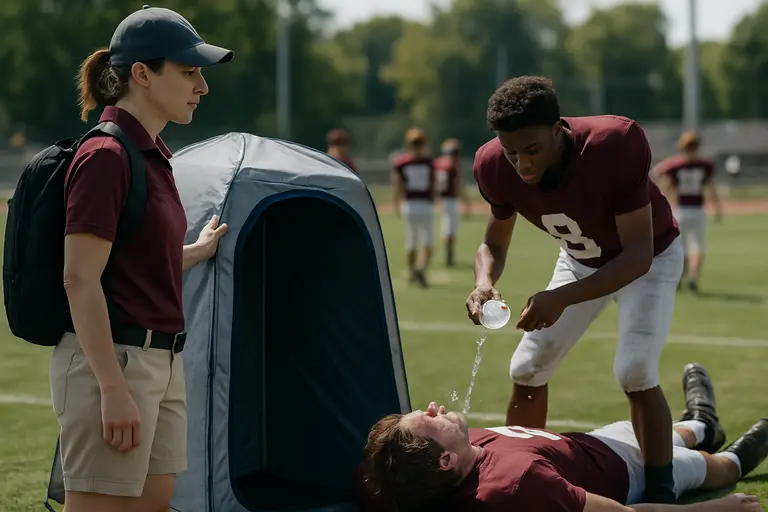
The UIL heat guidelines also pushed emergency planning into the center of practice operations. Rapid-cooling zones are required when WBGT reaches 79.7°F in Class 2 zones or 82°F in Class 3 zones, for practices and outdoor contests. The research notes say these zones must include tools for full-body immersion in cold water or the TACO method, which uses tarps, ice and water, and oscillation.
What A Rapid-Cooling Zone Means On Site
A rapid-cooling zone should be ready before an athlete needs it. That is the key mindset. If the WBGT threshold requires it, the equipment should not be locked in a storage room, sitting across campus, or waiting for someone to bring ice after symptoms appear. The research notes also say Emergency Action Plans must include onsite rapid-cooling capability for participants showing signs of heat illness, with trained personnel and equipment for cold-water immersion or tarp-assisted cooling available.
For school programs, this places heat response beside other game-day and practice-day operations. Just as coaches check balls, cones, helmets, scoreboards, and field access, someone should confirm the rapid-cooling setup. For parents, a fair question is simple: where is the cooling zone, and who is trained to use it?
Communication Keeps Families Aligned
The new standards can change practice length quickly. A session planned for three hours may be shortened if readings rise. A football practice planned with pads may shift to no pads. Conditioning may be removed when WBGT is above 90°F. Families need fast, plain communication so rides, meals, work schedules, and multi-child carpools can adjust.
A team message does not need to be long. It can say that the WBGT reading changed, practice duration was reduced under the heat plan, and pickup time has moved. That type of update helps families understand that changes are tied to a measured safety standard, not last-minute confusion.
Why UIL Heat Guidelines Matter For Texas Youth Sports
The value of the UIL heat guidelines is that they give Texas sports communities a shared language for heat. Coaches can point to a reading. Parents can ask about a record. Athletes can expect water access and true rest breaks. Athletic departments can connect practice plans with Emergency Action Plans.
There is still local work to do. The research notes do not list every district procedure, every campus setup, or every youth league policy. Families should ask their school or program how WBGT readings are taken, who keeps the records, where rapid-cooling equipment is placed, and how practice changes are communicated. Those answers will vary by campus, field layout, staffing, and sport.
For young athletes, the goal is not less sport. The goal is better sport: safer practices, smarter use of outdoor time, and a coaching culture that treats heat as a real performance and safety factor. Texas teams are used to preparing for tough conditions. Under the UIL heat guidelines, that preparation now starts with a reading, a record, a plan, and adults ready to act.