

Coach Technical Skills are being tested in real time during Texas Longhorns fall camp, which remains in progress as of September 3, 2026, with the season opener still ahead. For college staffs, high school coaches, and youth league leaders across Texas, the lesson is not only about scheme. It is about how fast players can learn, communicate, retain assignments, and compete for roles without losing trust in the process.
The Longhorns’ camp reports point to a staff balancing install work, young-player evaluation, position movement, and special teams sorting. Those are familiar pressures for local programs, even at a smaller scale. A coach with 28 varsity players, a middle school roster full of first-year athletes, or a select team mixing returning starters with new families faces the same central question: how do you teach more without creating confusion?
Coach Technical Skills From Texas Install Work
Coach Technical Skills For Install Pacing
Texas’ offense was reported to be about 70 percent through its play-installation process in late August 2026, leaving roughly 30 percent still to be completed before the offensive foundation was fully in place On3 fall camp report. That single number gives coaches a practical teaching point: installation is a sequence, not a dump of the whole playbook.
For local coaches, that means each new concept should have a clear entry point, a walk-through version, a full-speed version, and a review period. Younger players often nod in meetings, then struggle when motion, cadence, spacing, or fatigue enter the drill. Coach Technical Skills in this setting include knowing when to pause, when to repeat, and when to move on. A staff that treats retention as part of performance will see more than who is fast or strong. It will see who can carry learning from a whiteboard to the field.
The defensive side offers a second model. By late August 2026, Texas’ defense had essentially completed installation of Will Muschamp’s system, with many packages already in place, and reports noted crisp player communication, correct alignment, and very few mental mistakes during skills and drill periods Texas camp notes. That does not happen by accident. It points to repetition, clear language, and checks that players can repeat under pressure.
Why Install Speed Should Match Player Readiness
Ethically, install pace is also a fairness issue. If a coaching staff moves too fast, the players with prior private training, older siblings, or better access to offseason work may look far ahead, while new players fall behind before they have had a fair chance. That is especially true in youth leagues and school programs where families have different resources.
A responsible staff can protect competitive standards while still teaching with care. Coaches can use brief quizzes, small-group walk-throughs, peer checks, and position-specific reminders. They can track which athletes miss the same assignment twice and respond with teaching rather than public shaming. The goal is not to slow down ambition. It is to make sure the learning structure is clear enough that effort has a real path to improvement.
Teaching Processing, Retention, And Communication
Meeting Room Learning Must Show Up At Practice
One of the clearest fall camp themes is player processing. In August 2026, Steve Sarkisian framed the evaluation of true freshmen Tyler Atkinson and Richard Wesley around whether they knew what to do, could process meeting-room information, take it to the practice field, learn, apply it, and show it again the next day. That is a useful standard beyond college football.
Raw ability can win a rep, but repeatable understanding earns a role. Coaches can test this by giving players a short concept in a meeting, then checking for transfer during practice. Did the athlete align correctly without being moved? Did the player communicate the call to a teammate? Did the correction stick the next day? These questions are better than simply asking, “Do you understand?”
Communication also needs to be coached as a technical act. Defensive calls, offensive line IDs, route adjustments, return signals, and sideline reminders all require timing and clarity. A quiet player may know the assignment but fail to help the unit. A loud player may speak often but give unclear information. Coaches should grade both accuracy and delivery.
Feedback Loops That Build Trust
In local programs, feedback loops should be direct and consistent. A player should know whether a missed assignment came from alignment, communication, technique, or effort. Those are different problems. Treating them the same can damage trust and slow development.
Staffs can assign one coach to watch alignment, another to listen for calls, and another to chart execution during a short team period. This does not require college resources. It requires discipline. Even at youth levels, where volunteer coaches are common, a simple shared note sheet can prevent the same correction from being missed across practices. For newer coaches, resources on youth coaching in Texas can help connect practice design with player confidence.
Movement, Timing, And Position Flexibility
Large Athletes Still Need Agility Standards
Fall camp also showed why movement evaluation matters early. On Day 1 in August 2026, defensive lineman Justus Terry, listed in the research notes at 6-foot-5 and 289 pounds, was reported to have improved movement and to look more dynamic than in prior seasons Sports Illustrated camp observations. For coaches, the broader point is clear: size should not excuse poor footwork.
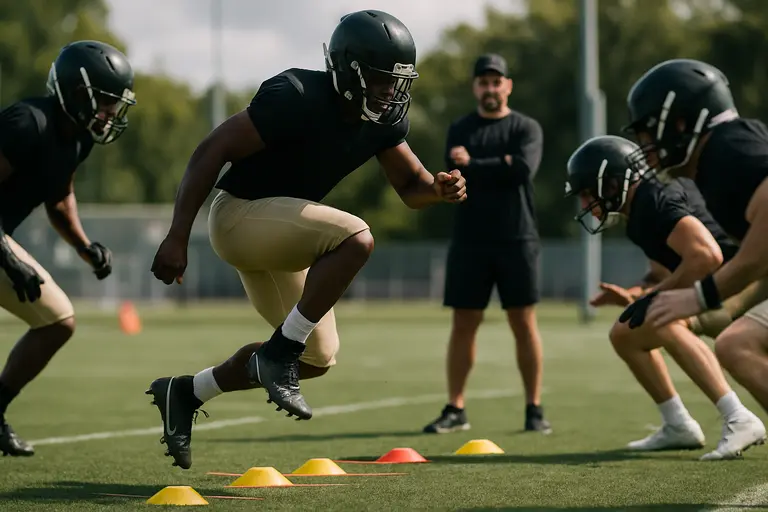
Big athletes need change-of-direction work, balance drills, controlled contact angles, and conditioning that protects movement quality. In high school and youth settings, larger players can be pushed too quickly into one role because they fit a body type. That can limit development. A better approach is to teach stance, first step, hand placement, and pursuit angles while still respecting age, growth, and safety.
Quarterback And Receiver Timing Needs Repeated Pressure
Texas camp reports also noted strong Day 1 chemistry between quarterback Arch Manning and receiver Ryan Wingo, including precision on a deep pass, with Wingo’s drop issue appearing controlled during that practice. Coaches at every level can take a simple lesson from that: timing is built through repeated, high-value reps, not just casual throwing.
Quarterback-receiver work should include landmark throws, late-hands catches, contested-catch periods, sideline spacing, and reset reps after a miss. If a receiver drops a ball, the next coaching cue should be specific: eyes, hands, stride, body position, or concentration through contact. Coach Technical Skills show up in how well the staff identifies the cause instead of labeling the player.
Position flexibility is another camp issue with local value. Research notes describe offensive line shuffling tied to injuries, with players acclimating to depth roles. For school and community programs, cross-training is often not optional. A backup guard may need center snaps. A tackle may need to learn the other side. Coaches should plan those reps before an injury forces the issue.
What Texas Fall Camp Means For Local Coaches
Competition Must Be Clear And Fair
Reports from Texas camp also point to young players pushing older players for reps, including rising names at safety and quarterback in the research notes. That is healthy only if the staff manages competition with clear standards. Veterans deserve respect for what they have earned. Newcomers deserve real chances to show whether they can help the team.
A fair rep plan can include rotating early-period reps, charting assignment grades, and separating effort from familiarity. Coaches should explain what earns more work: correct alignment, technique, communication, ball security, tackling form, or special teams value. Without that clarity, players may assume decisions are personal. With it, competition can lift the room.
Special teams should be part of that same evaluation. The research notes say Texas coaches were evaluating returners and adjusting depth charts during camp. Local coaches should treat return drills, coverage lanes, ball security, and blocking assignments as teachable periods rather than leftover time. Many young athletes earn early roles there, and poor instruction can create avoidable risk.
The lesson from Austin is practical for the full Texas football community. Coach Technical Skills include pacing installs, checking retention, coaching communication, teaching movement, building timing, and managing fair competition. Those skills help teams win, but they also support safer, more transparent player development. From college camps to Friday night programs to youth fields, the best teaching is measured by what players can repeat correctly when the drill becomes fast, loud, and competitive.