
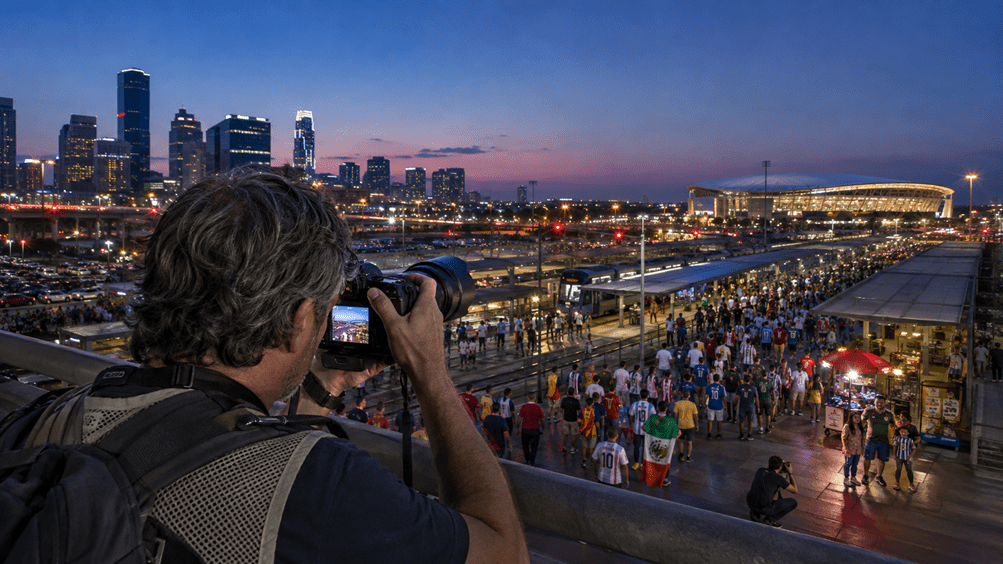
The 2026 FIFA World Cup gave Texas sports photographers a rare assignment: document a global tournament through a distinctly local lens. Fans now consume sports through photography, short-form video, schedules, travel information, statistics and state-specific topics ranging from ticket policies to sports betting in Idaho, yet the images that last tend to be much simpler. A supporter crossing a parking lot in national colors, a child seeing an international match for the first time, a stadium filling under Texas summer light or a photographer working from the edge of a massive crowd can say more about an event than another stream of numbers. Dallas-Arlington and Houston spent June and July 2026 showing why sports photography remains central to the way major events become part of a city’s memory.
Dallas Turned World Cup Scale Into A Photography Challenge
Dallas Stadium in Arlington carried an unusually heavy World Cup schedule. FIFA assigned the venue nine matches, the most of any host city, including five group-stage games, two Round of 32 fixtures, a Round of 16 match and the July 14 semifinal. That schedule created far more than nine opportunities to photograph soccer.
The scale mattered. FIFA lists Dallas Stadium at a capacity of 70,649, placing photographers inside a venue built to make people, architecture and spectacle compete for attention. A tight image of a midfielder or goalkeeper can still document the sporting action, yet a wider frame showing the roof, video boards, stands and supporter sections explains where the match took place and why the occasion felt different from an ordinary league weekend.
The Dallas World Cup venue schedule also meant visual storytelling had to evolve across several weeks. A group-stage afternoon carried a different mood from a knockout match. Fans arrived with different expectations. National colors changed. The tension outside the stadium rose as elimination games arrived.
Dallas expanded that visual territory beyond Arlington. FIFA’s host-city information identified the International Broadcast Center at the Kay Bailey Hutchison Convention Center and a 34-day Fan Festival at Fair Park. Those locations gave photographers several versions of the same tournament: elite competition inside the stadium, international media production downtown and public fan culture in a historic civic setting.
That variety is the larger lesson for Texas sports photography. The strongest event gallery does not need to contain 50 near-identical action shots. It can move from architecture to supporters, transportation, preparation, emotion, competition and the quiet minutes after a crowd begins to leave.
Houston Showed Why The Best Sports Images Start Outside The Stadium
Houston offered a different visual problem. FIFA assigned Houston Stadium seven World Cup matches, including two knockout-stage games. The city surrounding those matches became part of the assignment.
Houston established four activated World Cup clean zones covering the Central Business District, EaDo and the East End, the Galleria area and NRG Park. City guidance connected those districts with transportation planning, visitor activity and fan events. From a photographer’s perspective, that created a network of places where the tournament could be documented without pointing a lens at the pitch.
The city’s official Houston World Cup planning information described a Fan Festival in East Downtown and urged visitors to prepare for summer heat, security screening and matchday transportation. Those details might sound operational, yet they are exactly what gives sports imagery a sense of place.
A photo of fans waiting for METRO service tells a Houston story. So does a frame of supporters moving through EaDo, volunteers preparing a public gathering, families seeking shade or an international group arriving near the stadium. None requires a ball in the image.
Texas sports photography can become repetitive when every assignment begins at kickoff and ends after the final whistle. Houston demonstrated why the arrival sequence deserves attention. The city becomes visible before the game does.
For local photographers covering high school football, college athletics, baseball tournaments or professional teams, the same principle applies on a smaller scale. Parking lots, stadium approaches, concession areas, marching bands, families, equipment crews and neighborhood streets often reveal more local character than another isolated action photograph.
Fan Identity Became Part Of The Main Event
A World Cup is built around national teams, yet host-city photography is built around people.
Dallas welcomed supporters connected to teams including the Netherlands, Japan, England, Croatia, Argentina, Austria and Jordan during the group stage. Houston received its own mix of traveling supporters across seven matches. Each new matchup changed the colors, clothing, flags, gathering points and social energy surrounding the venues.
That diversity created a useful test for Texas photographers accustomed to familiar school colors or established professional fanbases. International tournaments require photographers to recognize that supporters are participants in the visual story rather than background decoration.
The City of Dallas maintained a dedicated World Cup visitor information hub covering transportation, public safety, neighborhood services and heat awareness. North Texas summer conditions were part of the experience, with the city warning visitors about extreme heat, thunderstorms and severe weather.
Those conditions affect photography in practical ways. Harsh afternoon sun creates deep facial shadows. Covered areas become natural gathering points. Sudden weather changes alter crowd movement. Night matches shift the scene toward stadium lighting, street reflections and illuminated architecture.
The best images use those conditions rather than hiding them. Texas heat, enormous parking areas, highway-scale movement and indoor-outdoor transitions help distinguish a North Texas World Cup gallery from coverage produced in another host city.
Fan photography requires restraint too. The objective is not to search every crowd for exaggerated reactions. Small moments often carry more weight: a parent adjusting a child’s jersey, two generations walking toward a stadium, visiting supporters comparing directions or a quiet fan remaining in a seat after elimination.
Those photographs build a record of what attending the tournament actually felt like.
Mega-Events Raise The Standard For Everyday Texas Coverage
A global tournament brings resources, access rules and production demands that most local assignments cannot match. Its visual lessons still transfer directly to Friday night football, high school basketball, college baseball and community tournaments across Texas.
The first lesson is preparation. Photographers need to know where the light is coming from, where fans enter, which parts of a venue provide elevation and when pregame activity will begin. Arriving only for the opening whistle gives away some of the most distinctive frames.
The second is sequencing. A useful sports gallery should read like an event rather than a burst-mode archive. An establishing image gives location. Details establish texture. Fan photographs introduce human context. Action carries the sporting narrative. Reaction provides consequence.
A third lesson involves restraint with equipment. Long lenses produce valuable action coverage, yet Texas sports culture often appears most clearly at shorter distances. A wider lens can place an athlete inside a packed high school stadium, show a baseball player against a dusty summer complex or capture a basketball team entering a small gym surrounded by local supporters.
The World Cup made the distinction clear. A technically perfect image of one player could have been made in many stadiums. A photograph combining the player, Texas venue architecture, international supporters and the scale of the occasion could exist only there.
That difference is what gives local sports photography lasting value.
Houston’s Post-World Cup Push Shows Why Images Matter After The Event
The strongest argument for photographing fan culture may have appeared after the final Houston World Cup match.
On July 23, 2026, Houston Mayor John Whitmire joined Houston Dynamo FC and Houston Dash in announcing 10,000 complimentary tickets for first-time attendees during the second half of their seasons. The initiative was explicitly positioned as a way to carry World Cup interest into the city’s professional soccer clubs.
Houston’s post-World Cup soccer initiative targeted families, youth programs and residents who had never attended a Dynamo or Dash match. That creates a visual story stretching well beyond the tournament itself.
A major sporting event leaves photographs of stars and stadiums, yet its deeper local effect can appear months later: a family attending its first professional match, a young player becoming more interested in soccer or a supporter returning to a local venue after experiencing the World Cup atmosphere.
For Texas Sports Image, that is where event photography becomes documentation rather than decoration.
The images worth preserving from 2026 are not limited to goals, celebrations or packed stadiums. They include how Texas cities presented themselves, how supporters used public spaces, how local families encountered global soccer and how those experiences fed back into the state’s everyday sports culture.
What Texas Sports Photographers Should Carry Into The Next Assignment
The World Cup offered Texas an unusually large stage, yet the principles it exposed are useful at almost every sporting event.
Photographers should look beyond the athlete holding the ball. They should photograph the venue before it fills, the people who make game day function, the supporters arriving from different communities and the details that identify the event as being in Texas rather than anywhere else.
That approach fits a state where sports identity is deeply tied to place. A high school football stadium in West Texas does not tell the same visual story as a soccer complex in Houston, a college baseball park in Austin or a packed basketball gym in the Rio Grande Valley. Treating every assignment as the same action-photo exercise removes the very regional character readers want to see.
The 2026 World Cup reinforced a simple standard: sports photography becomes more valuable when it explains both what happened and what it felt like to be there.
Dallas and Houston provided weeks of examples. The next challenge is applying that wider visual thinking to the ordinary Texas sports weekends that will keep producing meaningful images long after the World Cup has moved on.