
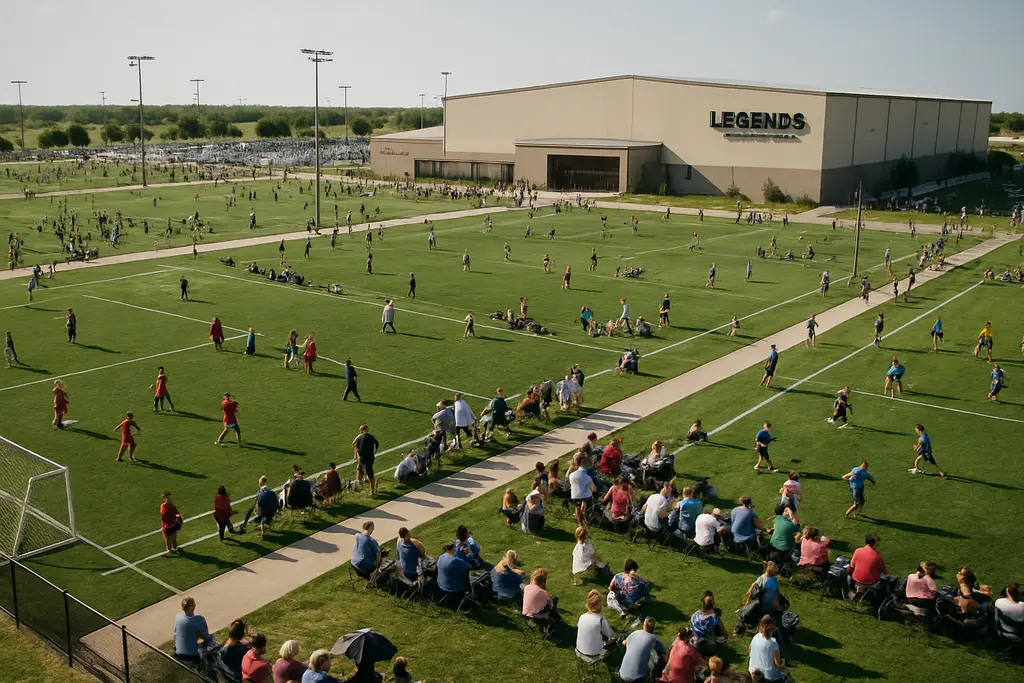
The Legends Event Center has become one of Bryan’s clearest examples of how youth sports can shape a city’s economy, identity, and access questions all at once. Since the venue opened in December 2022, the public conversation has grown beyond tournament schedules and hotel nights. Families, coaches, city leaders, and local businesses now have a shared stake in whether sports tourism also supports Bryan’s own young athletes in fair, visible, and lasting ways.
Legends Event Center Economic Impact For Bryan
Bryan’s indoor sports venue was built to host major youth and amateur events, and the reported results show why sports tourism has become part of the city’s development story. The facility is described by the City of Bryan as a 122,000-plus square-foot indoor sports and events venue with 16 volleyball courts that can convert into eight basketball courts, along with concessions, arcade space, an esports lounge, turf space, and flex space. The city also reported that the venue generated $15.9 million in summer economic impact in 2025 through sports tourism, according to a City of Bryan report.
The more recent research record for May through August 2026 showed an even larger summer figure: $18.2 million in economic impact for Bryan. That topped the summer marks listed for 2025, 2024, and 2023. Because October 21, 2026, is after that summer period, those numbers should be read as a past summer result, not as a future projection. For a city with a strong youth sports base, the growth shows how weekend tournaments can send visitors into hotels, restaurants, shops, and other local services.
What The Summer Numbers Say
The summer pattern matters because youth basketball, volleyball, camps, and regional tournaments often bring compressed visitor demand. Families travel in waves, teams book blocks of rooms, and local restaurants see tournament traffic between games. In 2025, six of the twelve basketball events at the venue generated $8.5 million for Bryan’s economy, based on the research record. That matters for local sports development because strong event demand can help keep the building active, visible, and attractive to event organizers.
Still, economic impact is not the same thing as athlete benefit. A sold-out event weekend may help local business owners while also limiting the hours available for hometown practices. That does not make tourism events wrong; it means the public story should include both the business return and the youth access question. Ethical sports communication should avoid treating young athletes only as drivers of spending. They are students, teammates, and community members first.
Youth Sports Development And Local Access
The research notes show that the venue supports youth sports not only through tournament hosting but also through weekly access for local youth athletic organizations, practices, leagues, camps, and clinics. That point is central. If local athletes get to train on the same courts used for national-level competition on weekends, the building can serve both the sports tourism mission and the player development needs of Bryan families.
For coaches, the facility’s value is not just square footage. It is predictable court time, weather-protected training, multi-court scheduling, and the chance to expose players to higher levels of competition without leaving town. For athletes, sharing a venue with major events can make big-stage sports feel closer. A middle school player watching older teams compete in the same building where she practices may see a clearer path from local league play to select events, varsity goals, and college conversations.
Legends Event Center Access For Local Athletes
Legends Event Center access should be measured in more than attendance totals. The key community question is whether Bryan-area children have fair chances to use the courts during practical time slots, at reasonable costs, and through programs that serve a range of skill levels. Elite tournaments can inspire athletes, but everyday access is where development happens. Ball handling, footwork, conditioning, teamwork, and coach feedback come from repeat sessions, not from a single showcase weekend.
This is where city-owned or city-linked sports facilities face a public trust test. The research record notes that an August 2026 City Council workshop raised the challenge of balancing large multi-day tourism events with local youth access. That is a real issue for any community sports venue that has become attractive to out-of-town tournaments. Revenue can support a facility, but the schedule should still leave space for the children whose families live, learn, and work in Bryan.
Families following facility growth may also find value in coach planning around LEC growth, especially as local programs think about court access, player goals, and training calendars after major tournament weekends.
Ethics, Legal Guardrails, And Public Trust
The ethical and legal lens starts with the basics: public resources, youth welfare, transparent scheduling, and fair treatment. This is not legal advice. It is a sports access and accountability view of a facility that has become closely tied to Bryan’s youth sports identity. When public officials discuss economic impact, families also deserve clear language about who benefits, who pays, and how local athletes fit into the plan.
The FY2026 proposed budget listed projected facility revenue of $2,468,800 for the event center, up 23.4% over the FY2025 adopted revenues, according to the city budget document. Since Fiscal Year 2026 ended on September 30, 2026, that figure should be described as a budget projection unless final audited figures are released. The distinction matters. Public trust depends on separating projections from completed results, especially in conversations about sports facilities, youth access, and taxpayer interest.
Questions Families And Coaches Can Ask
Good community oversight does not require cynicism. It requires asking practical questions before the schedule fills up and after major events leave town. Coaches and parents can keep the conversation sports-first by focusing on athlete development, safety, and access rather than treating the venue only as an economic engine.
- Scheduling: Are local leagues and youth organizations receiving usable practice windows, not only leftover times?
- Cost: Are court rental rates and program fees clear enough for families to plan?
- Development: Do camps and clinics serve beginner, intermediate, and advanced athletes?
- Transparency: Are tourism events and community-use blocks explained in a way the public can understand?
- Local benefit: Are Bryan athletes seeing training gains, not just watching out-of-town teams use the building?
These questions are fair because youth sports facilities carry more than financial expectations. They shape who gets to play, who gets seen, and which families feel welcome. A strong event schedule can coexist with hometown access, but that balance is easier to protect when city leaders, venue operators, coaches, and parents use shared facts.
Sports Tourism Results From 2023 To 2026

The reported summer figures show a steady climb in Bryan’s sports tourism return tied to the venue. The research record lists $7.4 million in summer 2023, $9.4 million in summer 2024, $15.9 million in summer 2025, and $18.2 million between May and August 2026. Those numbers show growth, but they also raise the stakes for governance. As outside demand rises, local access can become harder to protect unless it is named as a priority.
| Period | Reported Summer Economic Impact | Community Meaning |
|---|---|---|
| Summer 2023 | $7.4 million | Early proof of sports tourism demand after opening |
| Summer 2024 | $9.4 million | Growth in tournament-driven visitor activity |
| Summer 2025 | $15.9 million | Major step up in Bryan event traffic |
| May-August 2026 | $18.2 million | Highest summer figure listed in the research record |
The Fiscal Year 2026 research record also projected $40.14 million in economic impact tied to 38 tourism-based events, 38,571 room nights, 114,006 attendees, and $826,045 in local taxes. Since those figures were presented as expected FY2026 results, the careful phrasing is to treat them as projections unless final city reporting confirms the completed totals. That approach protects accuracy while still showing the scale of the facility’s sports business role.
Why Legends Event Center Access Matters In Bryan
The Legends Event Center story is not only about visitor spending. It is about whether Bryan can use a high-demand sports facility to support young athletes who live nearby, while still welcoming tournaments that help the local economy. That balance is possible, but it depends on honest reporting, practical scheduling, and a steady focus on children’s development.
For the Legends Event Center to remain a strong community sports asset, the public conversation should keep two ideas together: tourism events can bring real money into Bryan, and hometown kids should not become an afterthought inside their own facility. The best measure of success will be found in both places: economic reports that are clear and youth programs that give local athletes a fair place to train, compete, and grow.